
First in Class Drug: Sotorasib (KRAS inhibitor) for Lung Cancer
Ramesh Jayaraman, DoseQuantics Consulting
The KRAS (Kirsten Rat Sarcoma) gene is a rat oncogene homolog in humans that drives myriad cell functions through a network of signaling pathways. Cell growth-factors, which signal through receptor tyrosine kinases (RTKs), activate guanine nucleotide exchange factors (GEFs) that accelerate intrinsic RAS exchange activity and the formation of RAS-GTP which in turn binds to downstream effectors, like RAF,
and activates the ERK mitogen-activated protein kinases. The GTP-bound (ON) state transitions to the GDP-bound (OFF) state as GTPase-activating proteins (GAPs) stimulate the RAS-intrinsic GTPase activity. RAS binds and hydrolyzes guanosine-5′-triphosphate (GTP) to guanosine-5′-diphosphate (GDP).
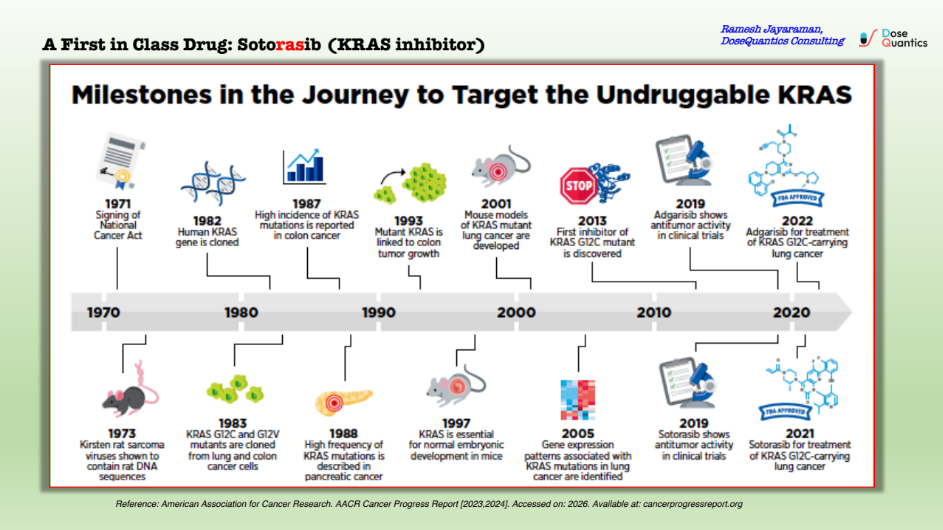
KRAS mutations are most frequently associated with pancreatic ductal adenocarcinoma and in non-small cell lung cancer. Oncogenic mutations in KRAS gene (missense mutations) result in mutant KRAS enzymes (e.g. KRASG12C, KRASG12D) that are permanently switched “on,” resulting in uncontrolled cell proliferation and cancer. Preclinical mouse models of pancreatic cancer showed KRAS involvement in tumor initiation, and presented a druggable target. Many attempts to target KRAS failed. Design of GTP analogues (inhibitors) to block GTP binding to RAS failed due to high affinity of RAS to GTP (picomolar concentrations). Indirect inhibition of KRAS function also was not successful in the clinic despite promising preclinical results. KRAS was therefore thought to be undruggable due to its protein structure which was not amenable to design inhibitors that bound to its active site (GTPase catalytic site)
After decades of research KRAS inhibitors that specifically bound to an oncogenic mutant version of KRAS (G12D) were identified. Promising preclinical activity paved the way to the development and approval of the first in class drug Sotorasib (Lumakras) for the treatment of non-small cell lung cancer (NSLC) carrying KRASG12C mutations.
References:
- American Association for Cancer Research. AACR Cancer Progress Report [2023,2024]. Accessed on: 2026. Available at: cancerprogressreport.org
- Closing in on cancer’s deadliest mutations. Nature. Vol 610. 27 October 2022
- Advances in RAS Therapeutics for Pancreatic Cancer. N Engl J Med 394;18 May 7, 2026