
Informed Experimental Design in Quantitative Pharmacology
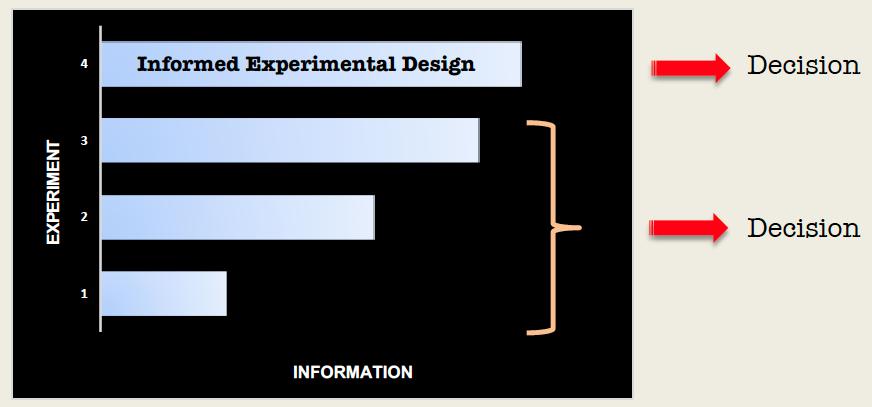
An in vivo study, be it pharmacokinetics (PK), pharmacodynamics (PD), or pharmacokinetic/pharmacodynamic (PK/PD), should be designed to yield data that enables a decision to be made in drug discovery projects.
This is particularly important as in vivo studies can be lengthy and often expensive. Poorly designed experiments may yield data that can be un-interpretable, incomplete and inconclusive and end up wasting time and resources while delaying decision making in the project.
An important component in experimental design is using available information on the candidate molecule, be it small molecule or biologic. This kind of experimental design is known as Informed Experimental Design.
Design of PK studies should be based in vitro ADME, physico-chemical properties and literature data, if available, for a molecule or a series of molecules belonging to a chemical or biological class. In silico PK models can also be used to predict PK in an organism. The design of PK studies can be based on the model predictions to confirm the predictions.
Design of pharmacology studies should be based on PK data combined with in vitro biochemical target potency, cell potency, nature of target-pathology link, and knowledge of type of pharmacological response such as immediate or delayed response (such as onset, time and duration of response) associated with the pharmacological effect. Pharmacological endpoints should be based on clinically relevant such as response in terms of disease reduction and associated biomarkers.
Doses selected for pharmacology studies should be such that there are adequate number of dose levels that are amenable to analysis of dose-exposure-response or PK/PD relationships. To the extent possible the PK should be assessed in the effect compartment so that pharmacological effect at the site of the target is associated with exposures.
Informed experimental design can save time, resources while simultaneously yielding quality data to support decision making in drug discovery and development projects.
- Ramesh Jayaraman
DoseQuantics Consulting Pvt Ltd