
Role of Pharmacokinetics/Pharmacodynamics (PK/PD) in Drug Discovery and Development.
Ramesh Jayaraman, Founder-Director, DoseQuantics Consulting Pvt Ltd, India
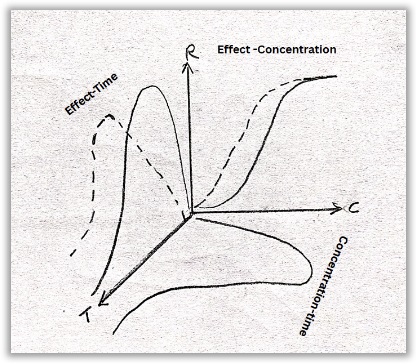
The process of discovering and developing a drug to obtain marketing approval is lengthy (approximately 8-10 years), risky (approximately 10% success rate), and expensive (average of 1 billion US dollars). Two major reasons for drug attrition in clinical development are lack of optimal pharmacokinetics (PK) and lack of efficacy (clinical benefit). The efficacy (pharmacodynamics (PD)) of a drug – the onset, intensity and duration of pharmacological effect is related to the time course of the concentration of the drug (PK) – exposure and half-life. Consequently, it is important to identify the optimum clinical dose, associated the optimum PK/PD combination, that will demonstrate maximum efficacy with minimal adverse effects. Hence, to minimize the risks of clinical failure it is important to optimize the PK/PD of a drug candidate as early as possible in the discovery program.
A drug discovery program is typically initiated based on a clinical need in a therapeutic area. Based on the clinical unmet need the properties required for the drug are defined in a target product profile (TPP). An important goal in the TPP is to set the dose, dose frequency and duration of the treatment that is required to achieve the desired clinical benefit (efficacy) without adverse effects. Thus, PK and PD form the basis for setting the optimum dose, regimen and treatment duration for a drug candidate to achieve clinical efficacy. PK/PD has applications throughout the drug discovery and development stages.
Preclinical stage: Lead identification is a key milestone in the preclinical stage. The lead compound (LC) must demonstrate proof of concept (PoC). This means that the LC should demonstrate efficacy in a relevant preclinical disease animal model supported with quantitative PK/PD (dose-exposure-pharmacologic response) relationships. When a quantitative PK/PD relationship (also known as Quantitative Pharmacology (QP)) has been established, an initial estimate of the clinical exposure (PK) required to achieve efficacy can be made. Failure to demonstrate efficacy (PoC) can be a setback for the project. Reasons for failure could be due to sub-optimal PK (e.g. poor bioavailability at site of drug target in tissues, short half-life) which can help the project to optimize PK properties to achieve the desired efficacy. Because the time course of pharmacological responses can be instantaneous or delayed in relationship the concentration time course, it is of critical importance to understand the temporal relationship of PK with PD (onset, intensity, duration). In such cases single dose PK/PD time course studies combined with repeated dose PK/PD studies are helpful to understand the temporal differences between PK and PD. Optimizing compounds based on PK alone can be misleading in such situations and has the risk of missing promising molecules.
The QP established for the LC forms the basis for lead optimization (LO), along with safety, to identify the preclinical drug candidate that has the potential to satisfy the criteria set in the TPP. QP can also help in ranking or prioritization of LCs based on their efficacy and potency in pharmacology models.
Mathematical PK/PD models can be developed in preclinical stages by linking PK and PD models for a molecule. These PK/PD models can be used to predict (simulate) time course of pharmacological effects based on different doses and regimens, which can support selection of optimum dose and regimens to achieve maximum efficacy. The preclinical PK/PD models can be extended to humans.
Clinical stages: In phase 1, the PK and safety of the candidate drug (CD) is evaluated by escalating doses in humans (healthy volunteers or patients). One of the goals is to determine the dose that achieves the pharmacological active exposures identified in preclinical studies, and also to understand if the PK is adequate to support the dose and regimen set in the TPP. Many clinical candidates fail in this stage due to inability to demonstrate the desired PK. Therefore, it is important to predict the PK of the candidate drug in humans with reasonable confidence before Phase 1 to assess the potential of the CD to meet the TPP criteria. Physiologically based pharmacokinetic (PBPK) models can predict PK in humans by linking drug specific properties (physico-chemical properties, in vitro ADME) with system specific properties (organ blood flow, disease states, demographics) using computational methods. PBPK models are extensively used to predict PK profiles in humans to assist selection of first time in human doses in phase 1 clinical trials. When PBPK models are linked to PD models, they can become powerful tools to predict PK/PD time course in humans. Combining the PK in humans with QP data from preclinical studies, along with PD data in humans obtained from biomarkers, helps in supporting the selection (recommendation) of the dose for phase 2 studies. A preliminary PK/PD model can also be developed in humans by either extending or refining the PK/PD model from preclinical species. The human PK/PD model for the CD can be used for simulations and support phase 2 dose and regimens.
In phase 2 studies, efficacy studies are performed in a limited number of patients using different dose levels or regimens to identify the dose and regimen for registration (phase 3) trials. Exposure -response data from patients can be compared with preclinical QP to evaluate predictive potential of preclinical PK/PD. Failure to demonstrate efficacy in phase 2 may be due to lack of PK/PD translation from preclinical models, and eventually be the reason for termination of the program. Hence it is important to understand the PK/PD of the CD in a pharmacology model that is as close to humans as possible. Analyzing quantitative PK/PD relationships with clinical efficacy using dose-exposure-response or PK/PD modelling helps in selection of dose and regimen that is predicted to demonstrate clinically significant efficacy in phase 3 studies.
PK and PD Population PK/PD models can be developed during phase 2 studies to understand the influence of demographics (age, sex, race) and comorbidities (impairment of liver, kidney function) on PK/PD of the CD. This helps in selection of the right dose for the population. PK models also help in predicting drug-drug interactions (DDI) which help in understanding the effect of the CD on PK of co-administered drugs or vice versa.
In registrational (phase 3) studies, the ability of the CD to demonstrate significant efficacy, in addition to safety, in a large number of patients is tested. This means that the dose selected for phase 3 should be strongly supported by PK/PD models in phase 2. Thus, when the CD demonstrates significant (clinically meaningful) efficacy it should be supported with PK/PD relationships. Population PK/PD models built in phase 2 can be further strengthened with data from large number of patients and can be used to tailor doses to specific populations. The dose and regimen associated with clinical efficacy is thus based on strong PK/PD foundation and safety, that can help drug regulatory agencies give confidence in decision making. Indeed, dose-exposure-response data from phase 3 studies are detailed in the prescribing information of the approved drug.
In summary, quantitative PK/PD (Quantitative Pharmacology) should be used for critical decision making early preclinical through clinical stages of drug development to minimize the failure of drug candidates.
References:
- P Chaikin 1, G R Rhodes, R Bruno, S Rohatagi, C Natarajan. 2000. Pharmacokinetics/pharmacodynamics in drug development: an industrial perspective. J Clin Pharmacol. 40(12 Pt 2):1428-38.
- Gabrielsson J, Green AR. 2009. Quantitative pharmacology or pharmacokinetic pharmacodynamic integration should be a vital component in integrative pharmacology. J Pharmacol Exp Ther. 331(3):767-74.
- Garralda E, Dienstmann R, Tabernero J. 2017. Pharmacokinetic/Pharmacodynamic Modeling for Drug Development in Oncology. Am Soc Clin Oncol Educ Book. 37:210-215.